Guide · OP11
OP11 "Manga" and the Listings With No Version Word
Bandai's official product page introduces OP-11 as "BOOSTER PACK -A FIST OF DIVINE SPEED-" and announces a "New theme 'SWORD' joins the battle!" that "Includes numerous new cards featuring the 'SWORD' traits!"
Last updated: 2026-10-31. Sources are Bandai's official card list and product page only.
The set's theme, in Bandai's words
Bandai's official product page introduces OP-11 as "BOOSTER PACK -A FIST OF DIVINE SPEED-" and announces a "New theme 'SWORD' joins the battle!" that "Includes numerous new cards featuring the 'SWORD' traits!" It notes the set "Features many popular characters from the Whole Cake Island arc" and that "A wide variety of new leader cards are now available!" That SWORD-and-Whole-Cake focus is the background to the "Manga" and version-word questions below. All wording here is quoted directly from the official Bandai product page.
The problem: a title that names a card but not its version
OP11 "A Fist of Divine Speed" leans on returning characters — Bandai's product page says "popular characters make a dazzling return with new colors and unique traits." Its most-swapped card is Luffy OP11-118, and the trap is simple: a listing can name the card and number without saying which version it is. The official card list fixes that; the market word "Manga" does not.
"Manga" is not an official label
The word "Manga" appears zero times on the official card list (series 569111). On the list, OP11-118 is three entries — OP11-118, OP11-118_p1, OP11-118_p2 — separated only by suffix and base rarity, with no "Manga," "Alternate Art" or "Parallel" text. So a listing titled "Manga Luffy OP11-118" may refer to any one of those three; the official list does not say which suffix carries the manga-style art, so this guide resolves the name to number + suffix and does not assign the art to a specific suffix.
The eight Special Cards, exactly as listed
A second source of "no version word" confusion is the Special slot. The list has 8 Special Card entries, every one a foreign number: - EB01-057_p2, OP05-119_p7, OP05-119_p8, OP06-119_p2, OP07-085_p2, OP09-005_p1, ST16-004_p1, ST18-005_p1.
Two official figures line up: the product page lists "Special Card x 6" plus "3rd Anniversary Special Card x 2," totalling the 8 the card list groups under "SP CARD." Both are quoted as-is; the product page simply splits out the two anniversary Specials (the OP05-119 pair) that the list folds into the same rarity.
The number-swap trap: some "OP11" cards are not on the OP11 list
This is the avoidance point to internalise. Not every card printed with an OP11 number lives on the OP11 list: - The list shows OP11-058 only as a single base entry; it has no _p1 here. - The list shows OP11-106 as OP11-106 and OP11-106_p1 only; it has no _p2 here.
So a listing advertising an "OP11-058 parallel" or "OP11-106_p2" is pointing at a card that is filed on a different set's official list, not OP11's. Always confirm the number is actually an entry on series 569111 before trusting the set name.
The single Treasure Rare
There is exactly one Treasure Rare in the list — OP09-015_p1 — an OP09 number carried in. It is neither a Special Card nor a "Manga."
Buy-before checklist
- A title with only a number and no version word tells you nothing: map it to number + suffix + rarity on the list.
- "Manga Luffy" = one of OP11-118 / _p1 / _p2; the list carries no manga label, so confirm the suffix.
- Special Cards are marked "SP CARD" and (in OP11) always carry a foreign number.
- Confirm an "OP11" parallel is actually on series 569111 — OP11-058_p1 and OP11-106_p2 are not.
- The one TR is OP09-015_p1, separate from SP and "Manga."
Vector diagram
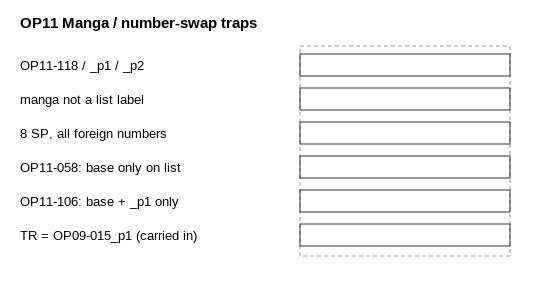
See fig_op11_manga_pitfall.svg: a line schematic of OP11-118's three entries, the 8 foreign-numbered SP, and the OP11-058 / OP11-106 numbers whose parallels are not on the OP11 list. No card images.
Sources and open items
- "Manga" absent as a label; OP11-118 / _p1 / _p2; the 8 SP ids; OP11-058 (base only) and OP11-106 / _p1 only; and OP09-015_p1 as the single TR: official card list https://en.onepiece-cardgame.com/cardlist/?series=569111 (re-fetched 2026-10-31).
- "Special Card x 6" and "3rd Anniversary Special Card x 2" (totalling 8): official product page https://en.onepiece-cardgame.com/products/boosters/op11.php (re-fetched 2026-10-31).
- Open: which OP11-118 suffix carries the manga-style art — not on the official list; no official/PSA basis quoted here, so not assigned.
- Open: PSA label wording for the SP / "Manga" cards — not accessed here.