Guide · OP12
OP12 Special Cards vs "Manga": Reading the List Instead of the Nickname
Bandai's official product page introduces OP-12 as "BOOSTER PACK -LEGACY OF THE MASTER-" and announces "The 'Dark King' Rayleigh joins the battle!", inviting players to "Unleash your Haki and claim victory with brand-new tactics!"
Last updated: 2026-10-31. Sources are Bandai's official card list and product page only.
The set's theme, in Bandai's words
Bandai's official product page introduces OP-12 as "BOOSTER PACK -LEGACY OF THE MASTER-" and announces "The 'Dark King' Rayleigh joins the battle!", inviting players to "Unleash your Haki and claim victory with brand-new tactics!" It adds that "The new 'Twin Wings' leader cards are here!" That Rayleigh / Twin Wings focus is the background to the SP-vs-"Manga" questions below. All wording here is quoted directly from the official Bandai product page.
Why SP and "Manga" get mixed up
OP12 "Legacy of the Master" is a 3rd-Anniversary-era booster — Bandai's product page frames it "around deep bonds," with the "Dark King" Rayleigh and a new "Twin Wings" leader. Its chase layer mixes two things buyers often confuse: the official Special Cards and the market word "Manga." The official card list draws a clean line between them; the nicknames do not.
The eight Special Cards, exactly as listed
The official card list (series 569112) has 8 Special Card entries, and every one carries a foreign number — none is an OP12 own number: - OP06-050_p2, OP09-013_p2, OP09-037_p2, OP09-093_p4, OP09-093_p5, OP10-082_p2, ST13-011_p2, ST18-004_p2.
Two official figures line up here: the product page lists "Special Card x 6" plus "3rd Anniversary Special Card x 2," which totals the 8 the card list groups under "SP CARD." Both figures are quoted as-is; the product page simply splits out the two anniversary Specials (the OP09-093 Teach pair) that the list folds into the same rarity.
"Manga" is not an official label
The word "Manga" appears zero times on the official card list. The market name "Manga Bonney" points at OP12-118, which the list shows as three entries — OP12-118, OP12-118_p1, OP12-118_p2 — distinguished only by suffix and base rarity, with no manga text anywhere. So a "Manga Bonney" is an OP12 own-numbered parallel (one of the _p entries), not a Special Card. The list does not state which suffix carries the manga-style art, so this guide resolves the nickname to number + suffix and does not assign the art to a specific suffix.
The single Treasure Rare is a carried-in number
There is exactly one Treasure Rare in the list — OP10-063_p1 (Vinsmoke Sanji), an OP10 number. It is neither a Special Card nor a "Manga"; it is a carried-in TR. Keeping it separate avoids a third layer of confusion with the SP and parallel cards.
How to tell them apart
- Special Card = marked "SP CARD" on the list and (in OP12) always a foreign number (OP06-/OP09-/OP10-/ST13-/ST18-).
- "Manga" = an OP12 own-numbered parallel such as OP12-118_p2, marked by its base rarity, with no manga label on the list.
- "Gold / Silver" Teach = the two SP entries OP09-093_p4 / _p5 (covered in the companion guide).
- Treasure Rare = the one OP10-063_p1, separate from both.
- When a title gives only a nickname, map it back to number + suffix + rarity before trusting it.
Two more official numbers, side by side
The product page lists the set as "128+1 card types" and "Secret Rare x 2," while the official card list shows 155 entries and 5 Secret Rares. Both are official and count different things (card types vs every entry including parallels and carried-in cards); this guide prints them side by side and does not reconcile them.
Vector diagram
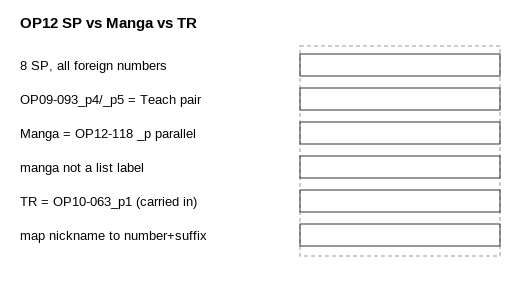
See fig_op12_sp_vs_manga.svg: a line schematic separating the 8 foreign-numbered SP entries from the OP12-118 own-numbered parallels ("Manga") and the single OP10-063_p1 TR. No card images.
Sources and open items
- The 8 SP entries and their exact ids, "Manga" absent as a label, the OP12-118 / _p1 / _p2 entries, and OP10-063_p1 as the single TR: official card list https://en.onepiece-cardgame.com/cardlist/?series=569112 (re-fetched 2026-10-31).
- "Special Card x 6," "3rd Anniversary Special Card x 2," "128+1 card types," and "Secret Rare x 2": official product page https://en.onepiece-cardgame.com/products/boosters/op12.php (re-fetched 2026-10-31).
- Open: which OP12-118 suffix carries the manga-style art — not on the official list; no official/PSA basis quoted here, so not assigned.
- Open: PSA label wording for the SP / "Manga" cards — not accessed here.